Take the Stairs (Just Not All of Them at Once)
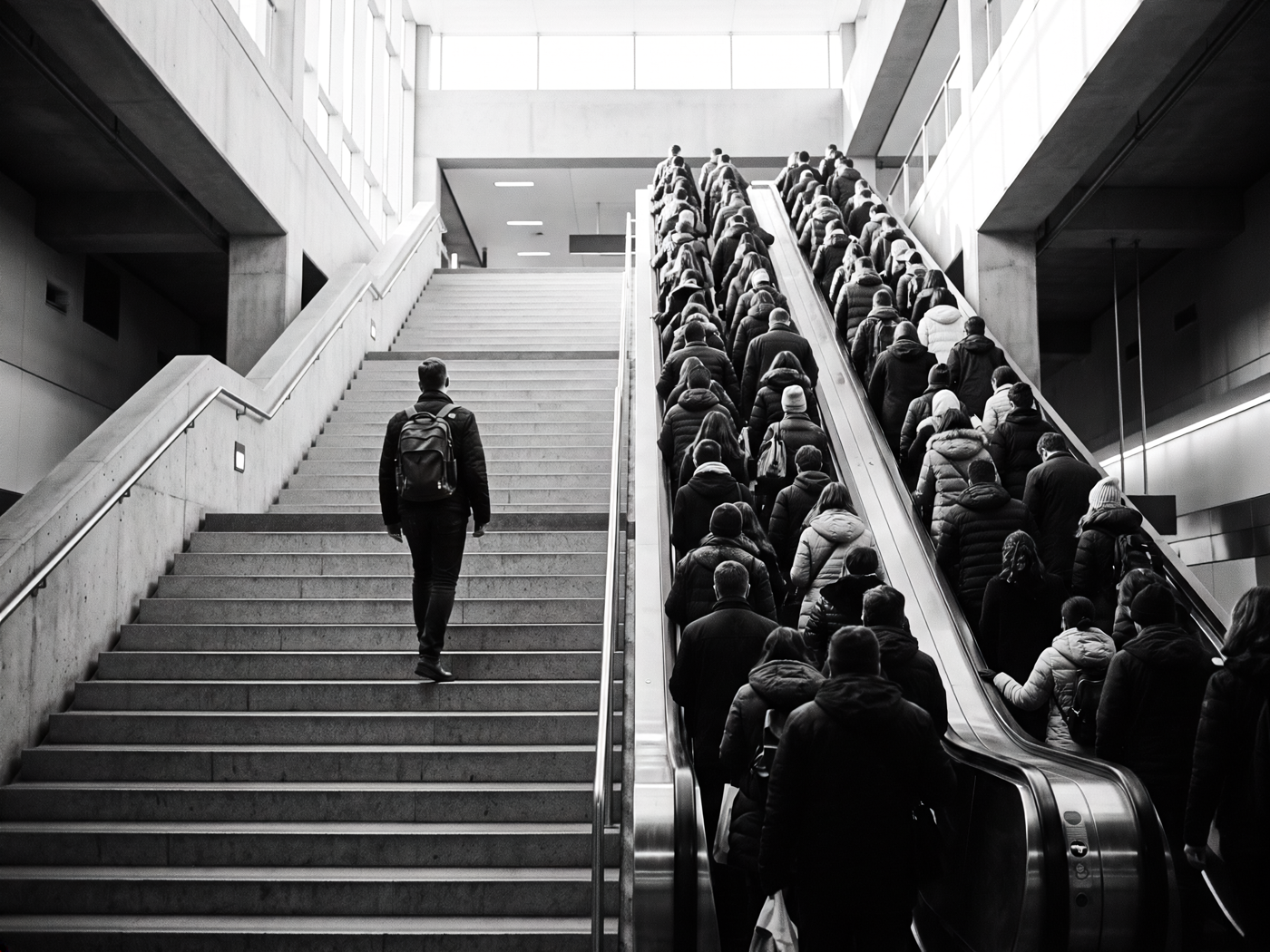
Stand at the bottom of any escalator that has a set of stairs beside it and watch for a minute. The escalator fills up shoulder to shoulder. The stairs stay empty. Every so often one person climbs them alone, and from where you're standing, that person looks like the odd one out.
I think about that picture a lot, because it is the clearest example I know of what modern life has done to us. Nobody on that escalator is lazy. They are doing exactly what the building was designed for them to do. The easy option was placed right there, and when the easy option is right there, almost everyone takes it. That is not a character flaw. That is human nature meeting good engineering.
Convenience Is Winning
The reality is, effort has been designed out of most of our days. Groceries show up at the door. The car parks a few feet from the entrance. Food arrives already cooked, already portioned, already engineered to be eaten fast. Each one of those is fine on its own. I use most of them.
The problem is what they add up to. The small physical demands a body was built around, carrying, climbing, walking farther than the parking lot, have quietly disappeared. And a body that is never asked to do anything hard slowly loses the ability to do anything hard.
So yes, we need discomfort. We need to go looking for it, because it is not going to find us anymore. That part I agree with completely.
Where the Discomfort Message Goes Wrong
Here is where I think a lot of people misunderstand it. They hear “embrace discomfort” and they assume the only alternative to the escalator is a thirty-story stairwell, on day one, at a sprint.
That is how most plans work. Maximal pain from the start. You go from a normal week to six workouts, no sugar, no carbs, no eating out, and a 5am alarm. The plan treats discomfort like a switch. Off, or all the way on.
I have done this more than once. Every time, it worked for a while, and every time, it ended the same way. Burnout. Mentally and physically. And then a long stretch of nothing, which is the most comfortable place of all.
If you have never climbed the stairs, the first flight is plenty uncomfortable. You do not need the whole building to feel it.
The Comfort Zone Chart Gets It Half Right
There is a leadership graphic that goes around every few months. Four circles, one inside the next. Comfort zone in the middle, then the fear zone, then the learning zone, then the growth zone on the outside. The message is that comfort is the enemy, and the farther out you push, the more you grow.
It looks great on a slide. It also looks exactly like how most diets treat eating. Monday you are in the drive-thru. Tuesday you are raw, sugar-free, and eating nothing that came in a package.
But there is one problem with the chart. That is not how behavior change works. Push too far, too fast, and the body and the mind do not toughen up. They break. You end up right back at the center of the circle, usually with less confidence than when you started.
The comfort zone was never the enemy. A comfort zone that stops growing is.
The goal is not to leave the comfort zone and live in fear. The goal is to make the comfort zone bigger. You add one thing that is hard, you keep everything that is familiar, and you hold that until the hard thing stops feeling hard. Then it belongs to you. Then you add the next one.
That is not moderation as a slogan. That is moderation as a method. Most habits do not need to be an all-or-nothing question. It was never sugar every day or sugar never, cook every meal or order every meal. The answer for most people lives in between, and it moves over time as your capacity moves.
What This Looks Like in Training
Let me make it concrete, because this principle shows up in exercise more clearly than anywhere.
- Pick one flight. Choose a single thing that is slightly harder than what you do now. Two strength sessions a week instead of none. A ten-minute walk after dinner. One more rep than last time. Not five changes. One.
- Hold it until it feels normal. The moment the new thing stops feeling like effort is not a signal to stop. It is the signal that your comfort zone just grew, and you are ready to add.
- Keep most of your week familiar. The hard piece sits inside a routine you can already sustain. If the whole week is new, nothing has a chance to stick.
- Expect the fear to shrink. The set that scared you two months ago becomes your warm-up. That is the entire mechanism, and it only works if you stay in the game long enough to feel it.
None of this means you never go to the deep end. You will. And most of the time you will find it is not nearly as bad as you imagined, which is exactly why gradual exposure matters. The people who get there are the ones who did not skip the shallow end.
I understand why the extreme version is tempting. It feels serious. It feels like you are finally doing something. But the person on the stairs did not get there by climbing the whole building on their first day. They got there by taking the stairs today, and again tomorrow, until it stopped being a decision.
Take the stairs. When they stop feeling hard, you will know what to do next.